
Microservices
Microservice architecture, or simply microservices, is a distinctive method of developing software systems that tries to focus on building single-function modules with well-defined interfaces and operations. The trend has grown popular in recent years as Enterprises look to become more Agile and move towards a DevOps and continuous testing. Microservices can help create scalable, testable software that can be delivered weekly
Why Microservices?
First let’s see the architecture that prevailed before microservices i.e. the Monolithic Architecture. In layman terms, you can say that its similar to a big container wherein all the software components of an application are assembled together and tightly packaged.
Below are the challenges of Monolithic Architecture:

Challenges of Monolithic Architecture
Unreliable – Even if one feature of the system does not work, then the entire system does not work
Unscalable – Applications cannot be scaled easily since each time the application needs to be updated, the complete system has to be rebuilt
Blocks Continous Development – Many features of the applications cannot be built and deployed at the same time
Slow Development – Development in monolithic applications take lot of time to be built since each and every feature has to be built one after the other
Not Fit For Complex Applications – Features of complex applications have tightly coupled dependencies
The above challenges were the main reasons that led to the evolution of microservices.

Differences Between Monolithic Architecture and Microservices
The main difference we observe in the above diagram is that all the features initially were under a single instance sharing a single database. But then, with microservices, each feature was allotted a different microservice, handling their own data, andperforming different functionalities.
Microservice Architecture

Microservices Features
Advantages Of Microservices
Best Practices To Design Microservices
In today’s world, complexity has managed to creep into products. Microservice architecture promises to keep teams scaling and function better.
The following are the best practices to design microservices:
The top 10 benefits that organizations realize from deploying microservices include:
6 potential drawbacks of microservices
Nothing is free, however, and microservice architectures do carry their own costs.
When used effectively, pay off
Used effectively, microservice architectures allow you to scale your application as the number of developers working on your application increases. The key is to build applications without creating a complex, unwieldy beast at the macro level. That means keep tracking each time a new service is added to your system or a new connection between microservices is made.
It also means examining the complexity increase and making sure it is warranted and well understood. Regularly examining the entire application system is critical to keep an interconnected set of microservices working effectively and reliably.
The benefits of microservices are clearly worth it for increasing numbers of modern software organizations. By changing how software development teams are structured, organizations can create teams centered on specific business services and give them both the responsibility and the authority to act as they see best. This approach lets teams quickly move with the business as it evolves in response to market demand without disrupting central business activities.
The breakup of the profiles of primary participants are given below:
By Company


By Region

Market Forecast

Microservice Architecture
- Different clients from different devices try to use different services like search, build, configure and other management capabilities
- All the services are separated based on their domains and functionalities and are further allotted to individual microservices
- These microservices have their own load balancer and execution environment to execute their functionalities & at the same time captures data in their own databases
- All the microservices communicate with each other through a stateless server which is either REST or Message Bus
- Microservices know their path of communication with the help of Service Discovery and perform operational capabilities such as automation, monitoring
- Then all the functionalities performed by microservices are communicated to clients via API Gateway
- All the internal points are connected from the API Gateway. So, anybody who connects to the API Gateway automatically gets connected to the complete system
Microservices Features
Features Of Microservices
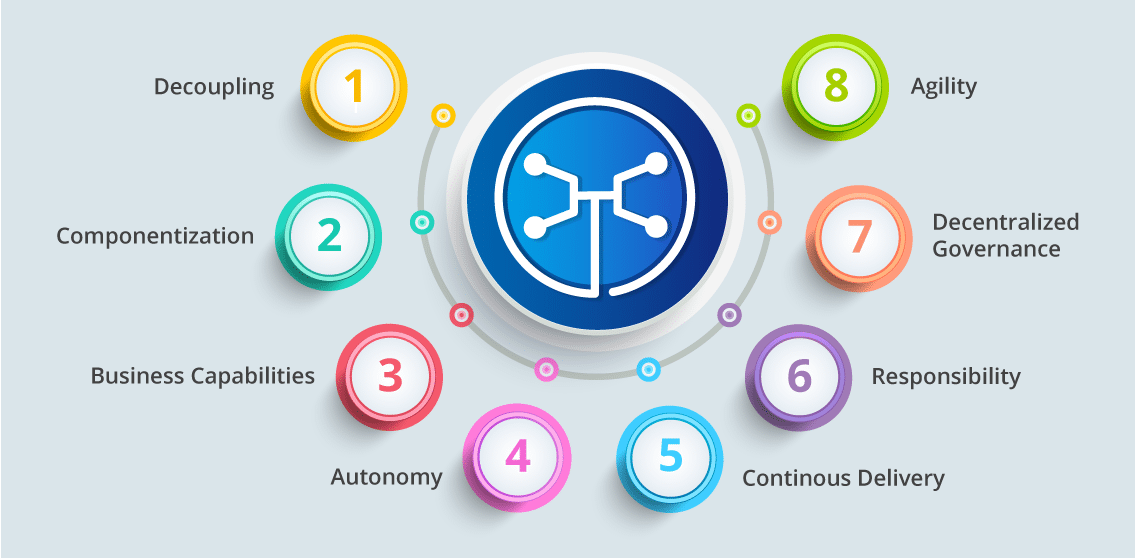
- Decoupling – Services within a system are largely decoupled. So the application as a whole can be easily built, altered, and scaled
- Componentization – Microservices are treated as independent components that can be easily replaced and upgraded
- Business Capabilities – Microservices are very simple and focus on a single capability
- Autonomy – Developers and teams can work independently of each other, thus increasing speed
- Continous Delivery – Allows frequent releases of software, through systematic automation of software creation, testing, and approval
- Responsibility – Microservices do not focus on applications as projects. Instead, they treat applications as products for which they are responsible
- Decentralized Governance – The focus is on using the right tool for the right job. That means there is no standardized pattern or any technology pattern. Developers have the freedom to choose the best useful tools to solve their problems
- Agility – Microservices support agile development. Any new feature can be quickly developed and discarded again
Advantages Of Microservices
Advantages Of Microservices
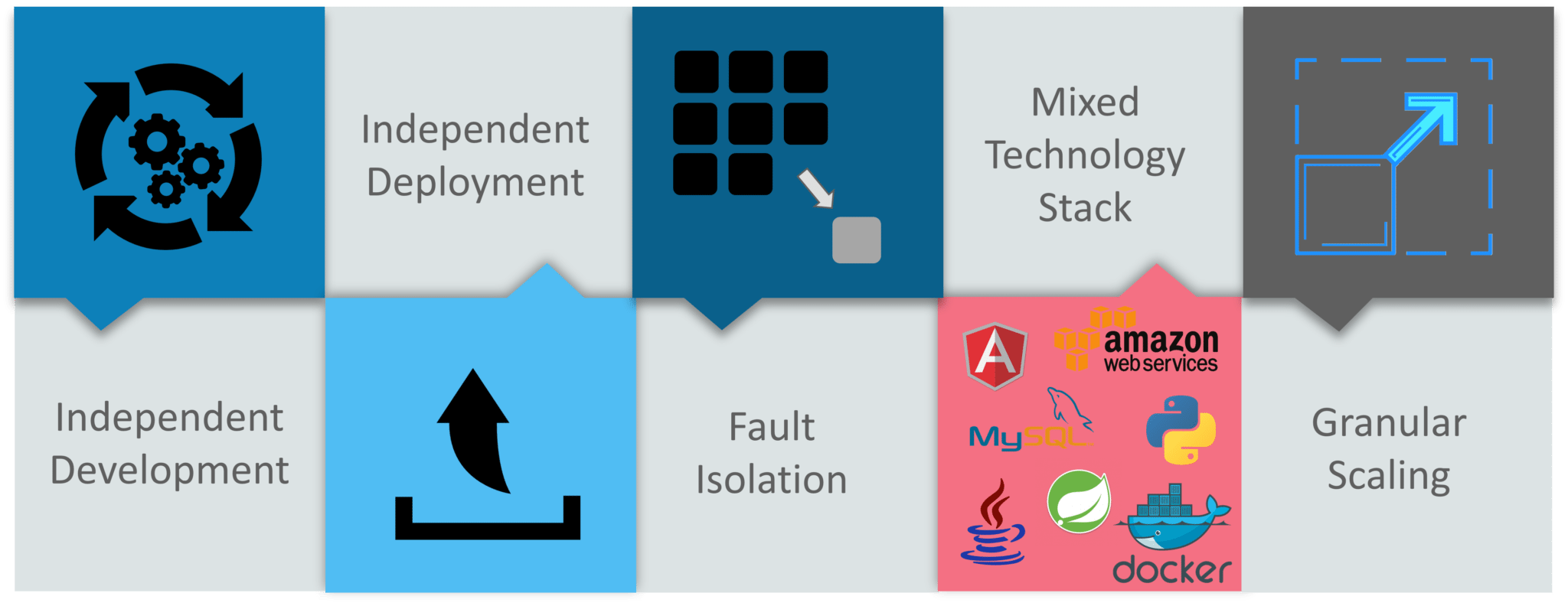
- Independent Development – All microservices can be easily developed based on their individual functionality
- Independent Deployment – Based on their services, they can be individually deployed in any application
- Fault Isolation – Even if one service of the application does not work, the system still continues to function
- Mixed Technology Stack – Different languages and technologies can be used to build different services of the same application
- Granular Scaling – Individual components can scale as per need, there is no need to scale all components together
Best Practices To Design Microservices
In today’s world, complexity has managed to creep into products. Microservice architecture promises to keep teams scaling and function better.
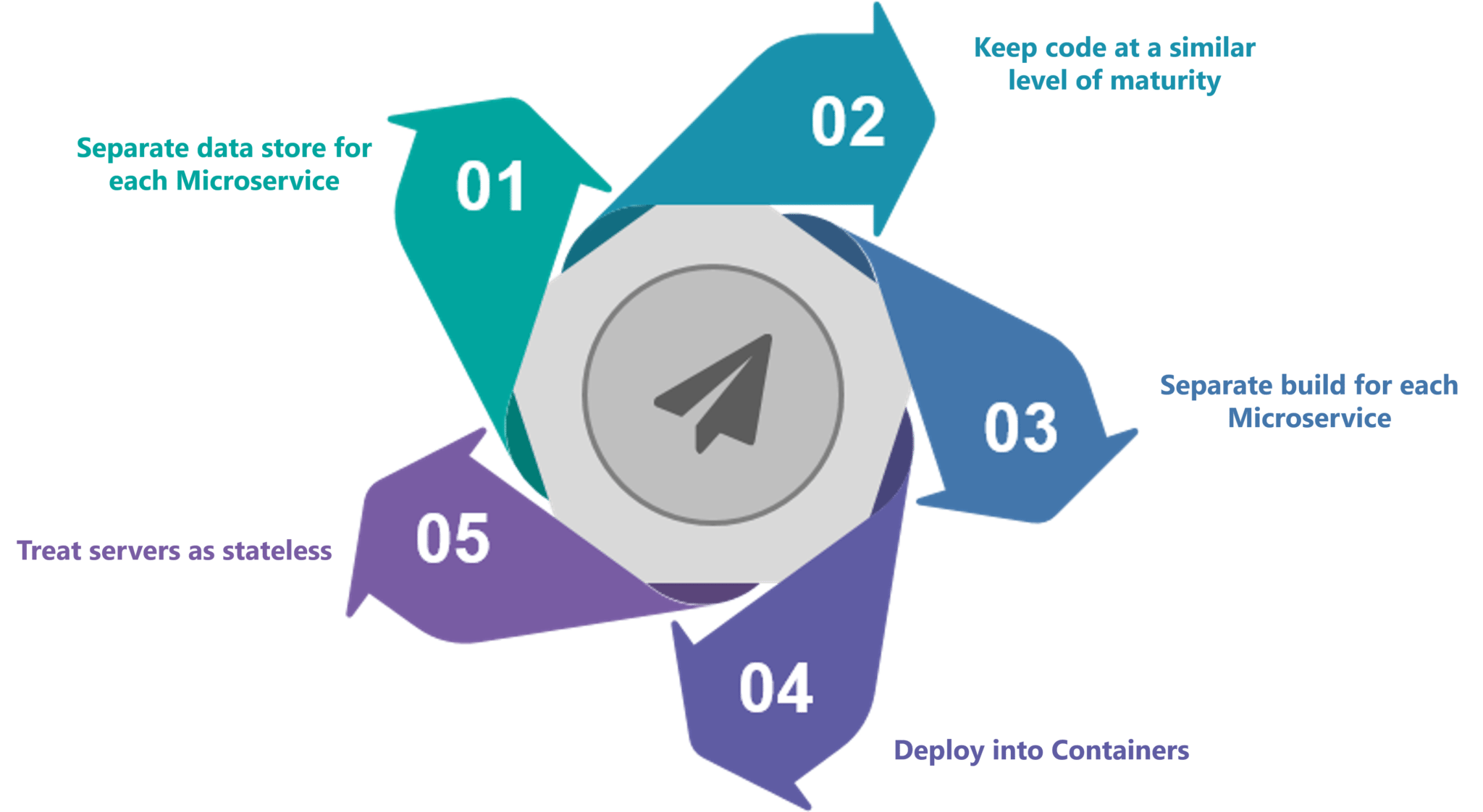
The following are the best practices to design microservices:
Best Practices To Design Microservices
Migrate applications to microservices
A microservice is a small application that usually houses one function. The function is exposed through APIs and messaging. Each microservice can have its own DevOps pipeline, scale individually, and have its own database where it owns a data model.
This figure shows how a monolithic application architecture evolves into a microservices-based application architecture:

In the monolithic application, the code is on a single server. When you update a single component, you must deploy other components at the same time, so you need a fully equivalent server to satisfy high-availability requirements through a blue-green deployment.
In the refactored microservices application, deployments of updates are simplified because business services operate independently on separate cloud-based compute infrastructure.
According to a recent survey by leanIX, organizations using microservices get new software to market five times faster than those that don’t. Most companies using microservices are so satisfied with the results that they plan to continue using them in the next six months. And 71% of them plan to increase their use of microservices in the next 12 monthsA microservice is a small application that usually houses one function. The function is exposed through APIs and messaging. Each microservice can have its own DevOps pipeline, scale individually, and have its own database where it owns a data model.
This figure shows how a monolithic application architecture evolves into a microservices-based application architecture:
In the monolithic application, the code is on a single server. When you update a single component, you must deploy other components at the same time, so you need a fully equivalent server to satisfy high-availability requirements through a blue-green deployment.
In the refactored microservices application, deployments of updates are simplified because business services operate independently on separate cloud-based compute infrastructure.
10 key benefits of microservices
The top 10 benefits that organizations realize from deploying microservices include:
- Improved scalability: Because microservices let you independently scale services up or down, the ease—and cost—of scaling is dramatically less than in a monolithic system. Adding new capabilities usually means adding discrete new microservices, not redoing the entire application, which increases both development speed and application stability.
- Better fault isolation: If one microservice fails, all the others will likely continue to work. This is a key part of the microservices architectural design.
- Optimized scaling decisions: With microservice architectures, scaling decisions can be made at a more granular level, allowing more efficient system optimization and organization.
- Localized complexity: Microservice architectures let developers think about services as black boxes. Owners of the service need to understand the complexity of only what is within their service. Other service owners need to know only what capabilities a service provides, without having to worry about how it works internally. This compartmentalization of knowledge and complexity makes it easier to create and manage large applications.
- Increased business agility: Microservices are relatively small and simple, and failure of a microservice affects only that service—not the whole application—so enterprises can afford to experiment with new processes, algorithms, and business logic. Microservices give you the freedom to experiment and “fail fast.”
- Increased developer productivity: New developers can get up to speed rapidly, since it’s easier to understand a small, isolated piece of functionality than an entire monolithic application.
- Simplified debugging and maintenance: For the same reasons that building individual microservices is easier than coding for a monolithic architecture, developers can be much more productive when debugging code and performing maintenance.
- Better alignment of developers with business users: Since microservice architectures are organized around business capabilities, developers can more easily understand the user perspective and create microservices that are better aligned with the business.
- Future-proofed applications: When innovations happen and new or updated technology disrupt your software development process, microservice architectures makes it easier to respond by replacing or upgrading the individual services affected without impacting the whole application.
- Smaller and more agile development teams: In modern software organizations, teams are often organized by the microservices they work on. These teams involve fewer people, and they’re more focused on the task at hand. Jeff Bezos’s famous “two pizza rule”—claiming that a software team that couldn’t be fed with two pizzas was too big—fits perfectly into the microservices philosophy.
6 potential drawbacks of microservices
Nothing is free, however, and microservice architectures do carry their own costs.
- Microservice architectures can be complex: While individual microservices may be easier to understand and manage, the application as a whole may end up with significantly more moving parts. There are often more components involved, and those components have more interconnections. Those interdependencies increase the application’s overall complexity, which can create problems.
- A microservices approach requires careful planning: Because all the microservices in an application must work together, developers and software architects must carefully plan out how to break down all the functionality and dependencies. You can also run into data challenges when starting an application from scratch or modifying a legacy monolithic app. In addition to carefully mapping out individual microservices, multiple iterations can be required until you get it right.
- Proper sizing of microservices is critical, and hard to calculate: If you make your microservices too big, you can end up with all the drawbacks of monoliths. If you make them too small, you move the complexity out of the individual services and into the dependency maps, which makes the application harder to understand and manage at scale. Worse, dealing with complex dependencies typically requires more experienced—and higher paid—developers and architects.
- You may have little control over third-party microservices: Many microservices architectures include services from third-parties, maintained by teams that you don’t have access to. Third-party services can change their APIs (or dependencies) at any time—and in ways that may break your application. If they do modify their APIs, you need to know and be able to respond ASAP.
- Downstream dependencies are difficult to track: One key to microservice success is to limit interdependencies and carefully track ones that you can’t avoid. The application must be able to survive failures of individual microservices, yet downstream problems often happen, and can cascade through the ecosystem. Building fault-tolerance into an application built with microservices can be more complex than doing so in a monolithic system.
- Multiple microservices may offer bad actors more opportunities: As microservices grow in popularity, they may increase your applications’ vulnerability to hackers and cybercriminals. Because microservice architectures allows you to use multiple operating systems and languages when building an application, there’s the possibility of having more “soft targets” for malicious intrusions. In addition, you may not have visibility into the vulnerabilities or behavior of third-party services used by your applications.
Used effectively, microservice architectures allow you to scale your application as the number of developers working on your application increases. The key is to build applications without creating a complex, unwieldy beast at the macro level. That means keep tracking each time a new service is added to your system or a new connection between microservices is made.
It also means examining the complexity increase and making sure it is warranted and well understood. Regularly examining the entire application system is critical to keep an interconnected set of microservices working effectively and reliably.
The benefits of microservices are clearly worth it for increasing numbers of modern software organizations. By changing how software development teams are structured, organizations can create teams centered on specific business services and give them both the responsibility and the authority to act as they see best. This approach lets teams quickly move with the business as it evolves in response to market demand without disrupting central business activities.
The breakup of the profiles of primary participants are given below:
By Company

By Designation

By Region

Asia Pacific (APAC) is expected to grow at the highest CAGR during the forecast period.
Among the major regions in the market, APAC is expected to grow at the highest growth rate during the forecast period.Technological advancements in various industry verticals, namely, BFSI, government, education, healthcare, transportation and logistics, and retail are expected to drive the market growth in APAC.
Currently, most organizations are fairly behind the curve in leveraging cloud microservices platform, but this is expected to change due to the availability of low-cost, cloud-based microservices. China, India, Japan, South Korea, and Australiaare some of the APAC countries expected to constitute a major portion of the global cloud microservices market.
In-depth interviews were conducted with Chief Executive Officers (CEOs), marketing directors, innovation and technology directors, and executives from various key organizations operating in the cloud microservices market.
The digital transformation is driving the global cloud microservices market
Currently, most organizations are fairly behind the curve in leveraging cloud microservices platform, but this is expected to change due to the availability of low-cost, cloud-based microservices. China, India, Japan, South Korea, and Australiaare some of the APAC countries expected to constitute a major portion of the global cloud microservices market.
In-depth interviews were conducted with Chief Executive Officers (CEOs), marketing directors, innovation and technology directors, and executives from various key organizations operating in the cloud microservices market.
The digital transformation is driving the global cloud microservices market
The global cloud microservices market size is expected to grow from USD 683.2 million in 2018 to USD 1880.0 million by 2023, at a Compound Annual Growth Rate (CAGR) of 22.4% during the forecast period. Digital transformation, proliferation of microservices architecture, and customer-oriented businesses are some of the factors expected to drive the global cloud microservices market. However, security and compliance may restrain the growth of the market.
References
References
https://en.wikipedia.org/wiki/Microservices
https://www.prnewswire.com/
https://www.marketsandmarkets.com/Market-Reports/cloud-microservices-market-60685450.html
https://www.ibm.com/cloud/garage/architectures/microservices/
https://microservices.io/
https://martinfowler.com/articles/microservices.html
https://www.devteam.space/blog/microservice-architecture-examples-and-diagram
Thanks for sharing the valuable information.
ReplyDeleteMicroservices Online Training